
You're Winning at Work and Losing at Home: Why High-Achieving Men Wait Too Long to Get Support

The Bottom Line: High-achieving men often succeed at work while quietly struggling at home: reactive, disconnected, or stuck in patterns they can't name. Men's Life Coaching with Manny Herrera at Maverick Marriage Therapy in Marietta, GA, offers a structured, private starting point: not therapy, but real, practical change.
I Know Exactly Where You Are, Because I've Been There
You're good at your job. Maybe great at it. People respect you in the room, trust your judgment, come to you when things fall apart. And somehow, at home, none of that seems to count.
I know that gap because I lived in it. For years, I battled the weight of addiction, unmanaged ADHD, unresolved trauma, and a victim mindset that left me feeling powerless and stuck. From the outside, I looked fine: functional, successful, even. I was closing deals, hitting goals, being the guy people came to.
Inside, I was caught in cycles of blame, frustration, and emotional chaos I couldn't name, let alone fix. The gap between how put-together I looked and how unmanageable things felt at home was the loneliest part of all of it.
I didn't break out of that by trying harder at the same things that weren't working. I broke out of it through structured, deliberate work. It's the same kind of work I now walk other men through in men's life coaching in Marietta, GA.
This isn't theory to me. It's the difference between the man I used to be and the one I get to be now: grounded, connected, and confident, instead of powerless and stuck. If you're reading this at eleven at night after everyone else is asleep, wondering if this is just how it is now, it isn't. Keep reading.
Why Successful Men Struggle at Home Even When Everything Else Is Working
At work, you're rewarded for exactly the traits that get you in trouble at home. Decisiveness. Control. The ability to spot a problem, propose a fix, and move on.
You bring that same transactional mindset home: diagnose the issue, offer the solution, expect resolution. And it doesn't land, because your marriage isn't a project you can close out. It responds to presence, not management.
This isn't a character flaw. It's a pattern, and patterns can be identified, understood, and changed, in that order. That's exactly how coaching works. Research backs up how common this is: only about a quarter of men say they'd be likely to seek help for something personal or emotional, even when they need it.
If you've been quietly carrying this alone, you're not the exception. You're the norm nobody talks about.
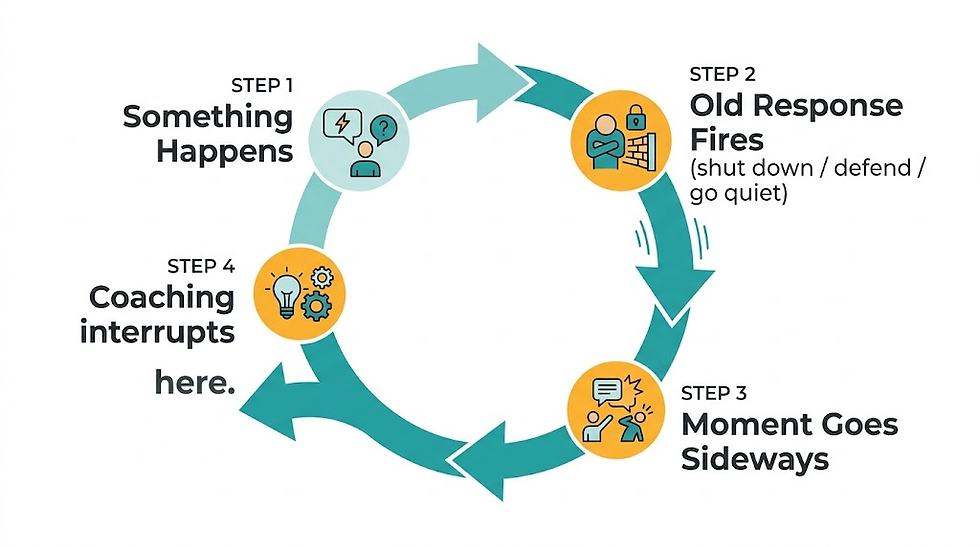
In my own life, and in the men I coach now, I've watched the same cycle play out: something happens, the old response fires before you can catch it, shutting down, getting defensive, going quiet. By the time you notice, the moment's already gone sideways. Your wife isn't asking you to fix her. She's asking you to stay present while something's unresolved, which is a different skill than the one that made you successful everywhere else in your life.
I draw on frameworks like Dialectical Behavior Therapy and Relational Life Therapy in my coaching, not because you need to be in crisis to benefit from structure, but because vague advice like "communicate more" doesn't hold up under real pressure. What holds up is knowing, specifically, what you tend to do when you're activated, and having a different move ready before you need it, not figuring it out in the moment, when it's already too late.
That might look as simple as naming what's happening out loud instead of going silent, or building in a deliberate pause before you respond instead of reacting on autopilot. Small, practiced moves. Not personality changes.
This is also where I push back on the idea that emotional awareness is the opposite of strength. It isn't. Staying present when everything in you wants to leave the room, literally or emotionally, is one of the harder things you'll do.
Emotional mastery is strength. It just doesn't look like the kind you've already been rewarded for. It looks like staying in the room, staying honest, and staying connected, especially when it's uncomfortable.
Signs a Successful Man Is Struggling at Home
Some of this may already sound familiar. The same patterns show up again and again in what I hear from men and the partners who love them. Here's what it tends to look like from the inside:
You're patient and easygoing at work, but short-tempered or shut down at home
You solve other people's problems for a living, but freeze when your spouse brings you hers
You've been told you're "checked out" or "not present," and while you don't fully disagree, you just don't know how to change it
Small conflicts turn into silence, withdrawal, or a blow-up that surprises even you
You're carrying something: old trauma, a habit you can't shake, something you've never had properly evaluated, and you've quietly decided it's not something you bring up
You've thought about getting support more than once, and talked yourself out of it every time
You keep telling yourself you'll deal with it once work slows down, and it never slows down
If two or three of these land, that's not a character indictment. That's a pattern with a name, and patterns can change.
Coaching vs. Therapy: How to Know Which One Actually Fits
Men ask me this constantly, so let me answer it directly instead of dancing around it.
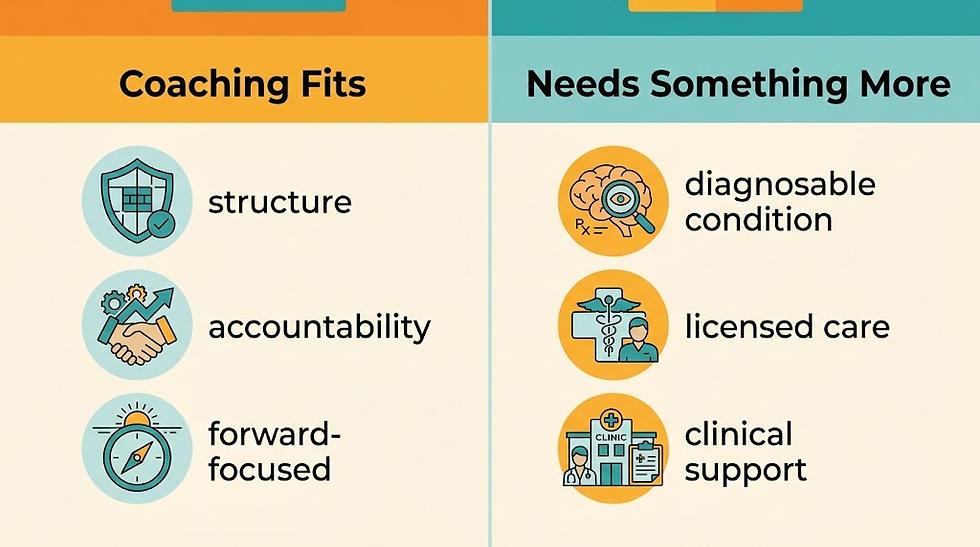
Coaching is forward-focused. It's structured, goal-oriented, and built around what you do next: communication, patterns, leadership, showing up differently at home. It doesn't diagnose or treat a mental health condition, and it isn't a substitute for therapy when therapy is what's needed.
When Coaching Fits
If you're functioning well, motivated to change, and what you need is structure, accountability, and a clear framework for doing things differently, coaching is built for exactly that. Most of the men I work with aren't in crisis.
They're stable, successful, and stuck in a pattern they can see but haven't been able to break on their own. They're the guys who know exactly what they're doing wrong in the moment and still can't stop themselves from doing it. That gap between insight and action is where coaching actually earns its keep.
When You Need Something More
Coaching isn't the right tool for everything, and I'd rather tell you that upfront than let you find out the hard way. If what's underneath this is a diagnosable condition, like unmanaged ADHD, unresolved trauma, depression, or an addiction that's actively running your life, that calls for licensed clinical care, not coaching alone.
I take that seriously enough that I've referred my own clients out when it was the right call. One client, Travis, came to me overwhelmed, juggling a demanding job, being a husband, a father, and a full-time student, all at once. Partway into our work together, I recognized patterns that looked less like a coaching issue and more like something clinical, and I referred him to a psychiatrist for a proper evaluation. He got a diagnosis, got treatment, and the coaching work we did after that actually landed, because we weren't trying to coach our way around something that needed a different kind of help first.
If that's where you are, Maverick Marriage Therapy has licensed clinicians for exactly this. If what you're carrying needs clinical care, not just structure, individual counseling in Marietta, GA with providers like Adam Levinthal, LPC, is there for you. And if the struggle is showing up mainly in your marriage rather than in you individually, that's a conversation for couples counseling in Marietta, not coaching.
None of this is about picking the "right" answer on your own. It's a conversation, not a test, and it's one you can have with me directly before you commit to anything. If you're not sure which side of that line you're on, that uncertainty itself is a completely normal place to start from. You don't need to self-diagnose before you reach out.
What Changes When You Do This Work
You don't have to have this figured out before you start. Most of the men I work with show up not knowing exactly what's wrong, just that something needs to change. Submit a confidential consultation request and we'll figure out the rest together.
Coaching isn't a personality overhaul. You don't come out the other side as a different person. You come out as more of who you already are, minus the patterns that have been running the show.
Practically, that means identifying the specific moments where the old response fires: a certain tone, a certain kind of silence, a particular kind of pressure. And it means building a different response before you're in the moment, not while you're in it. It means learning to sit in discomfort without needing to fix, flee, or shut down. It means, eventually, your wife noticing the difference before you even tell her there's been one.
This is structured work, not insight-only work. We don't spend months talking about your childhood so you can understand yourself better in the abstract. We build a clear process, track real, measurable shifts, and adjust as we go.
Most men I work with start noticing something different within a few weeks. The deeper, more durable changes (the ones your marriage feels) take longer, usually several months of consistent work.
That's not a sales pitch. That's just how change like this actually happens: slower than you want, faster than you expect, and only if you start.
You Don't Have to Tell Anyone You're Reading This
Here's something I don't say enough: you're allowed to start this on your own.
A lot of the men I talk to are quietly looking into this before they've said a word to their wife, not because they're hiding something, but because they want to know what they're considering before they bring it to her. That's not dishonest. That's taking responsibility for your own part in this before asking anyone else to change theirs.
If your wife doesn't know you're reading this right now, that's fine. Look into it privately. Book a consultation privately, if that's what makes it possible for you to start. Nobody at Maverick Marriage Therapy is going to call your house or loop anyone in without your say-so.
You can decide later what you want to tell her, and when. And if the work is real, she'll likely notice the difference before you ever have that conversation.
Being the one who moves first, quietly, on your own terms, is often the single most powerful thing a man in this position can do, for himself, and eventually, for his marriage.
What Happens When You Reach Out
If you're ready to look into this, here's exactly what happens. No surprises, no pressure.
You start with a free, confidential consultation call (about 20 minutes, by phone or video, whichever's easier for you). No script, no pressure. Just a real conversation.
I'll ask what's actually going on, what you've already tried, and what you're hoping is different six months from now. You can ask me anything: how I work, what coaching looks like week to week, what it costs, whether this is even the right fit for what you're carrying.
If it's a fit, we build a plan together, usually starting weekly so we build real momentum instead of losing progress between sessions, then adjusting frequency as things shift. If it's not a fit, if what you need is licensed clinical care instead, I'll tell you that directly and point you to the right person at Maverick Marriage Therapy, not string you along.
There's no obligation attached to the consultation, and nothing about it requires you to walk in with answers. You don't need the right words yet. You just need to be willing to have one honest conversation.
If you've read this far, some part of you already knows this is worth looking into. Schedule your free consultation and let's have that conversation.
You've spent years being the man other people count on. This is one place where you get to stop performing and start being honest about what isn't working, and start building something different, at your own pace, in your own time.
That's what men's life coaching with me is built for: not the idea that something's broken in you, but giving you the structure to change the patterns that are quietly costing you the relationship that matters most. You don't have to wait until it gets worse. You just have to be willing to start.
Schedule a free consultation: confidential, no obligation, and the only step you need to take today.
Disclaimer: This article is intended for general educational and informational purposes only and does not constitute clinical medical advice, psychiatric diagnosis, or treatment. Reading this content does not establish a therapist-client relationship. If you are experiencing significant relationship distress or individual mental health concerns, please consult a licensed mental health professional in your specific state or jurisdiction.
If you or your partner are in immediate danger, experiencing a mental health crisis, or having thoughts of self-harm, please call or text the Suicide & Crisis Lifeline at 988, dial 911, or go to your nearest emergency room immediately. Therapy is not a substitute for emergency medical care.
About the Author: Manny Herrera is a Men's Life Coach at Maverick Marriage Therapy in Marietta, GA, trained in Relational Life Therapy coaching, DBT, and the Gottman Method, and pursuing ICF certification through the Professional Christian Coaching Institute. He draws on his own experience overcoming addiction and unmanaged ADHD to help men build structured, lasting change at home. Learn more about Manny.
Clinically Reviewed By: Christina Neri, LCSW
Keep Reading: