
The Comprehensive Guide to Affair Recovery: Timeline, Steps, and Healing

Quick Answer: Affair recovery is a structured but nonlinear process that typically spans one to three years, depending on the depth of the betrayal, both partners' commitment to the work, and the quality of professional support. It moves through four overlapping phases — crisis, stabilization, rebuilding, and integration — and requires active, sustained participation from both the betrayed and the unfaithful partner. With the right therapeutic support, research shows that most couples not only survive infidelity but build a more honest relationship than they had before.
If You Just Found Out, Start Here
Discovery divides your life into before and after. Whether the truth arrived through a notification left open on a counter, a confession that came out of nowhere, or suspicions that finally got confirmed — the moment itself is the same: absolute, disorienting, unlike anything you've felt before.
If you're reading this in the hours or days after finding out, something needs to be said directly: what you're feeling is not an overreaction. The shock, the physical nausea, the inability to concentrate, the way your mind keeps circling back to the same questions — these are appropriate responses to a real rupture. Your nervous system is responding to a genuine threat.
Dr. John Gottman describes betrayal as existing on a spectrum, from what he calls "small dents" in trust all the way to a complete crash. Both ends of that spectrum deserve serious attention. An emotional affair with no physical contact can be just as devastating as a years-long physical affair, depending on the depth of the connection and the length of the deception. The pain is not a measure of your weakness. It is a measure of how much you trusted.
This guide covers what affair recovery actually looks like at each phase, realistic timelines grounded in research, what determines whether recovery succeeds, and when professional support is necessary. It is written for both partners — the betrayed and the unfaithful — because healing, when it happens, is something both people have to build.
What "Affair Recovery" Really Means — And What It Doesn't
It helps to be honest about what affair recovery is and what it isn't, because the gap between expectation and reality is one of the most common reasons couples stall.
Affair recovery is not: returning to the relationship you had before the affair, pretending it didn't happen, forgiveness as a single moment, or a process where one partner does all the emotional work while the other waits for things to normalize.
Affair recovery is: a deliberate, structured process of rebuilding trust, emotional safety, and intimacy that — when done fully — creates a new relationship rather than restoring the old one. It requires truth, time, accountability, and in almost every case, skilled professional support.
That last point matters more than people expect. Research consistently shows that couples who pursue structured therapy after infidelity have dramatically better outcomes than those who try to handle it on their own. Studies report that 60–75% of couples who engage in professional therapy after an affair successfully rebuild their relationship, compared to fewer than 20% who attempt recovery without help.
At Maverick Marriage Therapy, affair recovery counseling draws on several evidence-based frameworks suited to the specific wounds infidelity creates. The Gottman Trust Revival Method, built around the three-phase sequence of Atone, Attune, and Attach, provides the structural backbone. Cognitive Behavioral Therapy (CBT) addresses the distorted thinking that typically sets in after betrayal. Acceptance and Commitment Therapy (ACT) supports values-driven action through pain. Dialectical Behavior Therapy (DBT) provides emotional regulation tools for the acute phases when feelings become temporarily unmanageable.
Affair recovery counseling is genuinely different from general couples therapy. The trauma component of infidelity — the PTSD-like symptoms, the trigger management, the attachment rupture — requires a therapist with specialized training in betrayal and trauma, not just communication skills. Laura Cruz, MS, who clinically reviewed this article, holds specific Gottman training in Treating Affairs & Trauma, a designation distinct from standard Gottman certification and built precisely for this work.
The Four Phases of Affair Recovery: What to Expect and When
Recovery doesn't follow a straight line. Anyone who has worked with couples through this process knows that healing loops back on itself, that weeks of progress can feel undone by a single trigger, and that the timeline varies enormously between couples. What is consistent — across research and clinical experience — is the overall arc. Knowing where you are in that arc is one of the most stabilizing things you can have right now.
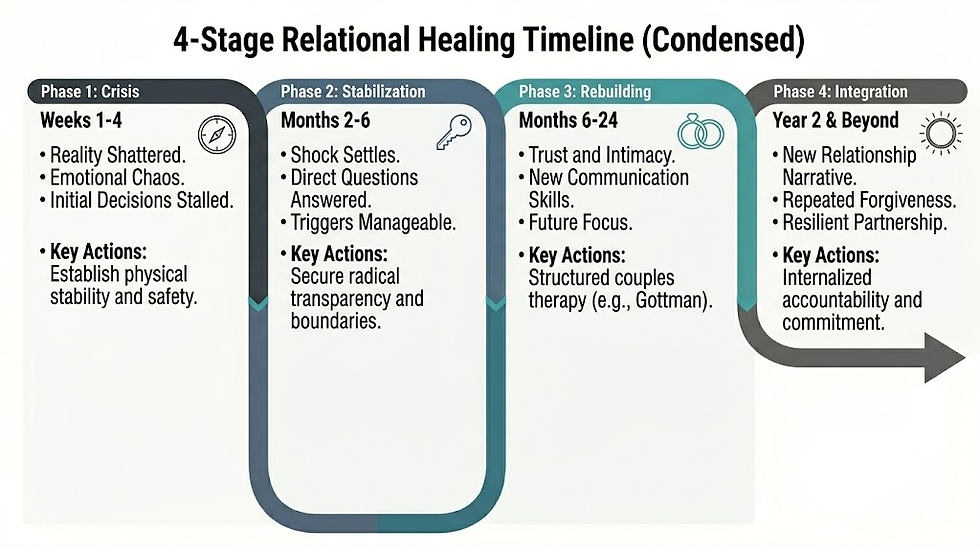
Phase 1: Crisis and Discovery Typical duration: Days to several weeks
What the Betrayed Partner Experiences
The immediate aftermath of discovery is best understood as a neurological event, not just a relational one. The betrayed partner's brain has had its model of reality shattered. What you thought was true about your relationship, your partner, and in many cases yourself, has been revealed as false. The mind's response to that kind of rupture is acute and total.
Expect intrusive thoughts that appear without warning and are impossible to shut off. Physical symptoms — nausea, inability to eat, inability to sleep, or sleeping too much. Emotional swings between numbness and overwhelming feeling, sometimes within the same hour. And relentless questioning: Who? How long? Did you love them? Did you think about me? These questions feel urgent and necessary, because they are. This is not obsession. It is the mind's attempt to rebuild a shattered reality map, piece by piece.
One of the most important things to understand in this phase is the impulse toward permanent decisions. The pain is so acute that ending the marriage immediately can feel like the only way to make it stop. So can the urge to tell everyone, to confront the affair partner, to make something — anything — happen. Slowing that impulse down is not weakness. Acting on it in the first days or weeks rarely reflects what you will want six months from now.
What the Unfaithful Partner Experiences
The unfaithful partner's experience in Phase 1 is often misread by both partners. There is frequently a moment of relief — the secret is over — followed almost immediately by a crash into shame, fear, and a kind of identity crisis that can be genuinely disorienting. "How did I become someone who does this?" is a real question, and it deserves a real answer eventually. In Phase 1, though, the unfaithful partner's job is not self-understanding. It is presence.
The two most common failure modes here are over-explaining and shutting down. Over-explaining — defending, contextualizing, listing reasons the affair happened — is received by the betrayed partner as blame and minimization, regardless of intent. Shutting down — going silent, retreating into guilt, becoming unavailable — abandons the betrayed partner at the moment they most need their partner to stay. Neither helps.
The essential obligation in Phase 1: full, honest disclosure, and complete cessation of the affair. Not a gradual reduction. Not "we're just friends now." Not maintained contact "for closure." The affair must end, completely and without ambiguity, as the precondition for any recovery to begin.
What Helps in Phase 1
Basic physical stabilization: consistent sleep as much as possible, eating even when appetite is gone, identifying one trusted person outside the relationship for support
Resisting the pressure to make permanent decisions in the acute phase
An emergency couples session to establish basic communication ground rules
Individual support — therapy, a trusted friend, a pastor or spiritual advisor — for both partners
The signal that Phase 1 is transitioning: Both partners can be in the same space without every conversation immediately escalating beyond the point of return.
Phase 2: Stabilization
Typical duration: One to six months
The initial shock begins to settle, and the actual work starts to become visible — which can paradoxically feel harder than Phase 1, because the numbness has worn off and what remains is the full weight of what happened.
What the Betrayed Partner Experiences
Triggers begin in this phase, and they can be relentless. A song. A name. A certain time of day. A street you drove down together. Triggers are not signs that recovery isn't working. They are the expected consequence of betrayal trauma (addressed in depth in the next section). Understanding them as a neurological reality rather than a character flaw changes how both partners respond.
The questioning that began in Phase 1 continues, often intensifying before it eases. The unfaithful partner's most important contribution to Phase 2 is answering those questions honestly, patiently, without resentment, as many times as they need to be asked. This is not punishment. It is the fundamental work of Phase 2, and the couples who make it through this phase intact are almost always the ones where the unfaithful partner understood and accepted that.
Phase 2 is also when the stay-or-go question becomes fully conscious and urgent. If either partner genuinely isn't sure whether they want to commit to recovery, this is the moment to address that before investing in the full therapeutic process. Discernment counseling is a structured, brief process built specifically for this moment — helping both partners arrive at clarity about which direction to go, without pressure toward any particular outcome, before committing to affair recovery work.
What the Unfaithful Partner Experiences
Phase 2 is where the difference between genuine remorse and guilt management becomes visible. It is also where many recovery attempts quietly stall.
Genuine remorse is oriented outward, toward the betrayed partner's pain. It asks: What did my choices do to this person I love? What do they need from me right now? Guilt management is oriented inward, toward the unfaithful partner's own discomfort. It asks: How do I make this stop? How long before things go back to normal? The betrayed partner can feel this distinction viscerally, even when they can't name it.
Accountability in Phase 2 also means radical transparency: shared access to devices and accounts, clear check-ins, willingness to answer location questions without defensiveness. This is not surveillance. It is the scaffolding that trust needs while it rebuilds, and it should gradually become unnecessary as the relationship stabilizes.
An apology that contains the word "but" is not an apology. It is an explanation. Phase 2 requires the unfaithful partner to understand, in genuine depth, the specific impact of their choices — not just the fact of the affair, but what it did to this person's sense of safety, their self-worth, their ability to trust their own perceptions. Only from that understanding can a meaningful apology emerge.
What Helps in Phase 2
Beginning structured couples therapy with an affair-specialized therapist — the earlier, the better
Individual therapy for the betrayed partner, particularly if betrayal trauma symptoms are present
DBT and ACT tools for emotional regulation during trigger episodes
A communication agreement: designated times for affair-related conversations, with boundaries that protect both partners from unsupported "ambush" discussions at unpredictable moments
The signal that Phase 2 is transitioning: Triggers are still present but manageable. The conversation can move beyond the affair itself, at least sometimes. Both people have made a deliberate, chosen decision to try.

Phase 3: Rebuilding
Typical duration: Six months to two years
This is the core work — the longest phase, the most active, and in many ways the most important. It is also the phase that produces the clearest evidence of why recovery, when it works, results in something genuinely new rather than a patched version of what existed before.
The Gottman Trust Revival Method structures this phase around the second and third stages of its framework: Attune and Attach. Attunement means rebuilding emotional connection — learning to hear each other again, to ask rather than assume, to respond to bids for connection rather than turning away from them. Attachment means reestablishing the physical, emotional, and relational intimacy that holds a relationship together over time.
Rebuilding Trust: The Mechanics
Trust does not rebuild through grand gestures. It rebuilds in small, consistent moments — what Gottman calls "sliding door moments": the micro-decisions made dozens of times a day to turn toward a partner or away from them. Choosing to check in without being asked. Following through on what was said. Being where you said you'd be. The accumulation of these moments, over months, is what trust is actually made of.
The transparency structures from Phase 2 — shared access, check-ins — should begin shifting in Phase 3 from obligation to choice. When the unfaithful partner offers transparency without being asked, it lands differently than transparency extracted by the betrayed partner's anxiety. That shift, when it happens, is one of the clearest signs that Attunement is taking hold.
Rebuilding Emotional Intimacy
Emotional intimacy after an affair requires both partners to learn a new way of being together — one that accounts for what happened rather than pretending it didn't. This means vulnerable conversation as a regular practice: sharing fear, uncertainty, and hope, not just the logistics of daily life.
Reflective listening is one of the most useful tools in this phase. Rather than responding immediately to what a partner says, the listener reflects back what they heard before adding their own response. It slows down the conversation enough to interrupt the defensive reactivity that becomes habitual after betrayal. When the betrayed partner says "I'm scared this will happen again" and the response is "of course you are — tell me more about what that fear feels like" rather than "I've told you it won't," something shifts.
The Gottman "Dreams Within Conflict" approach is particularly useful here: understanding what the affair revealed about unmet needs, longings, or relational patterns — not as justification or excuse, but as information about what the new relationship needs to include. Couples who do this work often describe a clarity and intentionality they never had before the affair.
Rebuilding Physical Intimacy
There is no timeline for when physical intimacy should resume after an affair. Pressure from either partner tends to deepen disconnection rather than bridge it. Some couples find their way back to physical closeness relatively quickly; others need many months. Both are normal.
Physical reconnection often works best as a gradient: non-sexual touch, proximity, physical affection — before sexual intimacy is reintroduced. Some couples experience an intense early return to physical closeness in the immediate aftermath of discovery, which can be confusing and disorienting for both partners. It is worth naming and discussing openly in therapy, because without context for understanding it, it can produce misread signals on both sides.
The Gottman framework recommends re-establishing emotional trust before moving toward sexual reconnection — not as a rule, but as a recognition that physical intimacy is most sustainable when it grows from emotional safety rather than the urgency to feel normal again.
Rebuilding Intellectual and Recreational Intimacy
This dimension of recovery is consistently underestimated and consistently meaningful. Shared curiosity, new experiences, and time together that isn't dominated by the affair creates associations between the relationship and something other than pain. Trying something neither partner has done before. A trip somewhere new. A class. A shared project. These aren't distractions from the recovery work. They are part of it.
What Helps in Phase 3
Continued Gottman-method couples therapy, with the Attune and Attach phases as the clinical framework
For couples who need concentrated, accelerated progress: couple intensive sessions compress months of therapeutic work into focused multi-day formats — an option well-suited to affair recovery, where prolonged low-grade instability can become its own problem
Individual therapy tapering as stability increases, with periodic check-ins for continuity
The signal that Phase 3 is transitioning: The couple can discuss the future without every conversation circling back to the affair. Real moments of genuine connection and safety are present — not performed, just there.
Phase 4: Integration
Typical duration: Year two through year three and beyond
Integration is the phase most people don't know to expect. Its absence is why some couples who have genuinely done the recovery work still feel like something is unresolved.
Integration does not mean forgetting. It means the affair is no longer the organizing principle of the relationship. It has been processed, understood, and incorporated into a larger story — one that includes the betrayal, the recovery, and what came after.
Forgiveness, in this phase, is best understood not as a single moment but as a decision made repeatedly over time. It is also worth being precise about what forgiveness is for: it is for the betrayed partner's freedom, not the unfaithful partner's absolution. Forgiveness is the release of the ongoing cost of carrying the wound, not the elimination of its reality.
Couples who complete the full recovery process frequently describe their rebuilt relationship in terms that surprise them. More honest. More intentional. More resilient. Not because the affair was worth it — it wasn't — but because the work of healing required both partners to become more present, more genuinely honest, and more deliberately committed than they had been before. Not every couple gets here. But it is a documented, real outcome for couples who see the process through.
The unfaithful partner's task in Phase 4 is ongoing accountability without martyrdom. Becoming trustworthy doesn't end at a finish line. It becomes, gradually, simply who they are — not something performed for their partner's benefit, but something genuinely internalized.
Understanding Betrayal Trauma: Why This Feels Like PTSD
One of the first things Laura Cruz does with a betrayed partner in early recovery is give them a framework for what they're experiencing — not as emotional instability or weakness, but as a documented trauma response with a clinical name and a path forward.
"I give them language for what's happening in their nervous system," Laura explains. "When someone can understand that they're not 'going crazy' — that the intrusive thoughts and the physical reactions and the hypervigilance are a predictable response to a genuine threat — something shifts. The self-blame starts to ease a little. And that matters enormously for what comes next."
Betrayal trauma is a specific form of psychological trauma first identified by psychologist Jennifer Freyd in the early 1990s. Freyd's central insight: the more you depend on someone, the more damage their betrayal inflicts. When the source of danger is also your source of safety — when the person who hurt you is the same person you would normally turn to when you're hurting — the nervous system faces a conflict it was never built to resolve.
Research consistently shows that 30–60% of betrayed partners experience symptoms that meet or closely approach the clinical threshold for PTSD — intrusive thoughts, emotional flashbacks, hypervigilance, physical reactivity to triggers, disrupted sleep, difficulty concentrating. These are not signs of fragility. They are signs of a nervous system that experienced a genuine threat and is doing exactly what nervous systems do.
This matters for treatment. Standard couples advice — "just communicate more," "use your 'I' statements," "schedule a weekly check-in" — fails when the nervous system is in a trauma state. The brain's threat-detection system is active and the prefrontal cortex, where deliberate communication skills live, is effectively offline. Trauma-informed therapy isn't optional for serious affair recovery work; it's foundational.
What helps with betrayal trauma symptoms:
When triggers fire — and they will — the most effective response from the unfaithful partner follows a three-step sequence: Empathize first. Reassure second. Report third. Empathize with the pain being experienced right now. Offer reassurance about the present safety of the relationship. Then, and only then, share information or context. Any sequence that starts with explanation or defense makes the trigger worse. The betrayed partner's nervous system needs to register safety before it can take in information.
Individual therapy runs alongside couples work for most betrayed partners with significant betrayal trauma symptoms. CBT addresses the distorted beliefs that take hold — "I'll never be able to trust anyone again," "I must have done something to deserve this." ACT helps defuse obsessive thought loops without suppressing them. In some cases, trauma-focused approaches may be appropriate for processing the acute material directly.
Individual counseling — separate from the couples work — also matters for the unfaithful partner. It provides space to examine the conditions and choices that led to the affair, to address shame in a way that's useful rather than paralyzing, and to develop the genuine empathic capacity that Phase 3 requires.
Triggers at month fourteen do not mean recovery isn't working. They mean healing is still happening. The goal is not the absence of triggers. It is the ability to move through them without being flattened by them.
What Separates Couples Who Heal from Those Who Don't
Affair recovery is not random. Whether a couple makes it through is not primarily a matter of luck, or the severity of the betrayal, or how long the marriage has lasted. It is predicted, with considerable consistency, by a specific set of variables — most of which are within the couple's control.
Complete cessation of the affair. Not reduction. Not "we're just friends now." Not maintained contact out of concern for the affair partner's wellbeing. Recovery cannot begin or be sustained while the affair continues in any form. Research on disclosure and secrecy is unambiguous: one five-year longitudinal study found divorce rates of approximately 80% in couples where the affair remained secret, compared to 43% in couples where it was fully revealed. The affair must end, completely, as the precondition for everything else.
Honest, complete disclosure. The "trickle truth" pattern — where additional details come out over weeks or months after the initial disclosure — is one of the most reliably destructive dynamics in affair recovery. Each new revelation re-traumatizes the betrayed partner and wipes out whatever trust had started to form. Full disclosure is painful. It is also the only foundation that holds. Couples who survive that initial pain together are in a fundamentally different position than couples who have to revisit it repeatedly.
Genuine remorse, not guilt management. The distinction has been described above, but it bears repeating here because it is the hinge on which so much turns. Remorse is oriented toward the betrayed partner's pain. Guilt management is oriented toward the unfaithful partner's relief. The betrayed partner can feel the difference. Couples where the unfaithful partner never fully makes that shift are the couples who stall in Phase 2 and stay there.
Willingness to understand, not just to forgive. The question "why did this happen?" is not about excusing the affair. It is about understanding the conditions — relational, individual, circumstantial — that allowed it to happen. That understanding is not the same as justification. It is the information a rebuilt relationship needs to actually be different from the one that preceded the affair.
Sustained professional support. The Gottman Trust Revival Method demonstrated a 75% success rate in its initial clinical trial. That figure reflects structured, therapist-guided work — not self-directed effort. The emotional intensity of affair recovery, the trigger management, the structured processing of meaning, and the skill-building required for rebuilding all require professional support. The couples who make it are, overwhelmingly, the couples who got help.
Both partners choosing to try. A betrayed partner cannot want recovery enough for two people. An unfaithful partner going through the motions under implicit threat of divorce is not in recovery — they are managing a crisis. Both people have to be genuinely in the process. Which is precisely why the question of commitment deserves its own attention before the full recovery work begins.
When Recovery May Not Be the Right Path
Affair recovery requires two people who are both choosing it — fully, actively, without one foot already out the door. When that mutual commitment isn't present, attempting the recovery process doesn't simply fail to work. It can cause real harm: deepening resentment in the partner who has already decided to leave, and crushing hope in the partner who is still investing.
There are circumstances where affair recovery may not be the right starting point — a pattern of repeated infidelity without genuine accountability, ongoing contact with the affair partner that won't fully end, coercion or control in the relationship before or during the affair, or betrayal trauma severe enough that basic safety cannot be established in the joint therapeutic space.
This is not about giving up easily. It is about an accurate read of what is actually present.
If either partner genuinely isn't sure whether they want to commit to recovery — or if one partner has already made a private decision that hasn't been said aloud — the right starting point is discernment counseling, not affair recovery therapy. Discernment counseling is a brief, structured process that holds the uncertainty alongside both partners, without pushing toward any particular outcome, and helps each person arrive at clarity about which direction to go. It is not a strategy to save the marriage. It is a process for making a genuine, informed decision.
For partners who conclude that leaving is the right path, healing from the betrayal is still possible — and still necessary — on a different track. Individual counseling provides space to process the grief of what was lost, to rebuild a sense of self that wasn't shattered by the affair, and to move forward with some integrity, whatever the relationship does.
How Affair Recovery Counseling Works at Maverick Marriage Therapy
Affair recovery sessions at Maverick Marriage Therapy look different from a standard couples appointment, starting at the first session.
The initial meeting is an assessment: where each partner currently is, the individual histories and attachment patterns that shape how each person is processing the aftermath, and the basic safety and communication agreements that make structured therapeutic work possible. Affair recovery is not a protocol applied uniformly. It is a process shaped to the specific dynamics of each couple.
The Gottman Trust Revival Method — specifically the Treating Affairs & Trauma protocol that Laura Cruz is trained in — provides the clinical framework. This is not general Gottman couples therapy. It was built to address the three dimensions that infidelity specifically ruptures: the trauma of the betrayal, the loss of meaning in the relationship's history, and the attachment injury that both preceded and followed the affair.
Alongside that framework, additional modalities are integrated based on what each couple needs. CBT for addressing the distorted beliefs that become entrenched after betrayal — "I'll never be able to trust again," "this means the whole marriage was a lie." ACT for committed, values-based action through the pain of recovery rather than waiting until the pain is gone. DBT for the acute emotional dysregulation that can make productive conversation temporarily impossible.
For couples whose schedules, distance, or the urgency of their situation makes weekly sessions insufficient, couple intensive sessions offer a concentrated alternative — compressing months of therapeutic work into focused multi-day formats. Affair recovery benefits in particular from the continuity and depth that an intensive format provides.
Laura sees clients in person at the Marietta, GA office and offers telehealth for clients in Illinois. A free consultation is the first step — a conversation, not a commitment — and the place to figure out whether affair recovery counseling, discernment counseling, or individual therapy is the right starting point for where you are right now.
Frequently Asked Questions About Affair Recovery
How long does affair recovery take?
Most couples doing active, supported recovery work need one to three years to reach genuine integration. The 18-month mark is commonly cited in Gottman research as a turning point — when both partners typically begin to feel something that resembles stability rather than constant crisis. This timeline varies significantly based on whether the affair has fully ended, whether complete disclosure has happened, the severity and duration of the betrayal, and both partners' investment in the work. Couples who pursue structured therapy move through the process more reliably than those who attempt it alone.
Can a relationship really be stronger after an affair?
Yes — with an important caveat. Not every couple gets here, and it is not a guaranteed outcome of simply surviving the process. Couples who do the full recovery work — including understanding what the affair revealed about unmet needs, relational patterns, and individual blind spots — often build something with deeper honesty and greater resilience than what they had before. The affair itself is never worth what it costs. But the work of healing from it, done fully, changes both people.
What's the difference between affair recovery counseling and regular couples therapy?
Affair recovery counseling requires specialized training that general couples therapy does not. The trauma component of infidelity — the PTSD-like symptoms, the trigger management, the attachment rupture — requires a therapist with specific training in betrayal and trauma, not just communication skills and conflict resolution tools. Laura Cruz's Gottman Treating Affairs & Trauma certification is a distinct credential, built specifically for this distinction. When selecting a therapist for affair recovery, ask directly about their training in infidelity — not just couples therapy generally.
Should we try to recover if my partner is still in contact with the affair partner?
No. Full cessation of the affair — including all contact — is the non-negotiable precondition for recovery work to begin. This is not a therapeutic preference or a jealousy accommodation. It is a clinical reality: meaningful healing cannot be established while one partner is still actively engaged in the relationship that caused the harm. "Staying friends" or "maintaining contact for closure" are incompatible with recovery. The contact must end, completely, before anything else can be built.
Does the unfaithful partner need individual therapy too?
Often, yes — and more often than people expect. The unfaithful partner's individual work — examining the choices that led to the affair, addressing shame in a useful rather than paralyzing way, developing genuine and sustained empathy for their partner's pain — materially accelerates the couple's shared recovery. Partners who invest in their own individual therapy alongside the couples work show deeper, more consistent accountability. This is available through individual counseling at Maverick Marriage Therapy, both in-person in Marietta and via telehealth.
What if I'm not sure I want to save the marriage?
That uncertainty is not a problem to be solved quickly. It is an important question that deserves its own process. Committing to affair recovery therapy when one partner privately has doubts about the marriage does not serve either person. Discernment counseling is the right starting point — a brief, structured process built specifically for this moment of ambivalence, without pressure toward any particular outcome. Many couples find that the clarity they gain through discernment counseling allows them to enter affair recovery work with a genuine, chosen commitment rather than a reluctant one.
Does Maverick Marriage Therapy offer faith-integrated affair recovery?
Yes. For couples whose faith is central to how they understand their marriage and their healing, a faith-integrated approach is available. This holds the clinical rigor of evidence-based frameworks alongside space for spiritual reflection — without requiring it. Your faith does not need to be checked at the door, and it will not be imposed on partners for whom it isn't present.
Do you offer support for individuals, not just couples?
Yes. Individual therapy for betrayal trauma is appropriate both alongside couples work and for partners whose spouse is unwilling or unable to participate in the recovery process. Healing from betrayal is possible regardless of whether the relationship continues. Individual counseling at Maverick Marriage Therapy provides space to process, grieve, and build forward — in person in Marietta or via telehealth for Illinois clients.
You Don't Have to Figure This Out Alone
There is a particular isolation that comes with affair recovery that most people don't anticipate. You can't post about it. You can't call most friends without managing their reaction. Your family will have opinions that may not serve you. The clergy or community you might otherwise turn to may not have training in this specific kind of wound. So you end up carrying something enormous, largely alone, at exactly the moment when carrying it alone is the hardest thing imaginable.
"What I want people to know," says Laura Cruz, "is that what you're going through has a shape. It has phases, and a direction, and a way through. The couples I've worked with who find their way to the other side of this — they're not the ones who had the mildest betrayal or the easiest circumstances. They're the ones who found support and stayed in it. That's the whole formula."
Laura sees clients in person at the Maverick Marriage Therapy office in Marietta. For clients in Illinois, telehealth is available. If you're not sure where to start — whether affair recovery, discernment counseling, or individual therapy is the right first step — a free consultation is exactly the place to find out.
📞 770-913-6557 📧 support@maverickmarriagetherapy.com 🌐 Schedule a free consultation →
About the Clinical Reviewer
Laura Cruz, MS is a therapist at Maverick Marriage Therapy specializing in couples recovery, infidelity, and betrayal trauma. She holds a Master of Science in Clinical and Health Psychology and a Bachelor of Science in Psychology, with over 13 years of clinical experience working with couples through some of the hardest chapters of their relationship. Laura is trained in the Gottman Method at both Level 1 and Level 2, with specific certification in the Gottman Treating Affairs & Trauma protocol — a specialized designation distinct from general Gottman certification. She is also trained in Cognitive Behavioral Therapy (CBT), Dialectical Behavior Therapy (DBT), Acceptance and Commitment Therapy (ACT), and Mindfulness-Based Interventions. A former adjunct faculty member, she brings academic depth alongside clinical experience. Laura offers therapy in English and Spanish, and sees clients in person at the Maverick Marriage Therapy office in Marietta, Georgia.
Published by Maverick Marriage Therapy 4343 Shallowford Rd. Suite 510, Marietta, GA 30062 support@maverickmarriagetherapy.com | 770-913-6557
This article is written and clinically reviewed by licensed clinical professionals and is intended for educational purposes only. It does not constitute clinical advice or establish a therapeutic relationship. If you or your partner are in a mental health crisis, please contact a licensed professional or call 988 (Suicide & Crisis Lifeline). Maverick Marriage Therapy is a licensed counseling practice serving clients in Georgia and Illinois.


